
Bank, bankruptcy reforms, Nabard Bill amendment on agenda.

According to him, since India has a low fiscal deficit, a low current account deficit and lower inflation, there is no need for being too dependent on foreign money for growth.

The Reserve Bank of India (RBI) has advised the public not to succumb to the temptation of fictitious offers of large funds through e-mails from unknown entities.The RBI clarified that under FEMA restrictions on transfer of funds also apply to lottery-like schemes functioning in different names such as money circulation scheme or remittances for the purpose of securing prize money/awards etc.
The Reserve Bank of India is expected to do a balancing act by further liberalising limits on the foreign exchange outflow to tackle the capital inflow and its impact on inflation. The central bank was likely to raise the limit on corporate investment abroad and the ceiling on individual remittances overseas. RBI has liberalised limits on the overseas investment by companies from 200% to 400% of their networth. Liberalisation is proposed since India has good forex situation.

The notice, under provisions of the Foreign Exchange Management Act, has been issued by the Mumbai office of the agency after its probe found that the group has 'contravened' the law as it failed to comply with Reserve Bank of India norms by not declaring funds generated by some wholly owned subsidiaries the group had raised overseas few years back, according to ED sources.
Alleging breach of contract and intended violation of the Foreign Exchange Act, the Indian Hockey Confederation (IHC) has requested the Reserve Bank of India to stop payment of US $500,000 by the 2010 World Hockey Cup organisers to the International Hockey Federation (FIH).
The government today said the proposed Financial Stability and Development Council, an inter-regulatory agency headed by the finance minister, would not act as a super regulator.

'We want to send a notice to the BJP that Rajputs are no longer their slaves.'

The cabinet also approved ordinance to amend the RBI Act to extinguish the liability on the old notes.

'Thankfully, most investors in India have now seen through this false narrative and are once again deploying their hard-earned money.

If RBI has to replace the entire stock of Rs 1,000 and Rs 500 notes with Rs 100 ones, the cost would be more than Rs 10,000 crore.

The party also promised reservation to minorities on basis of their population after the caste census.

83% of the CEOS plan to hire more in the new year.

Jaitley's Budget has the potential to change the face of Modi's Bharat

As many as 641 customers across 19 banks have been duped of Rs 1.3 crore using stolen debit card data

The gross bad debt of the Indian banking system as of March was at Rs 7.11 lakh crore

Indian brokerage arm of global investment banker Morgan Stanley has sought RBI's approval to start proprietary trading under which it will be able to buy and sell securities on its own account.
Since the start of the year, the RBI has had to contend with rising inflation and increased liquidity in the financial system causing it to raise CRR and repo rate to reign in the excess money.

The total amount of money various entities have raised through the private placement route is at its lowest since 2014. They raised a total of Rs 1.96 trillion in the first five months of 2022, revealed the numbers from PRIME Database. It is down 23.4 per cent from the Rs 2.56 trillion raised in the corresponding period in 2021.
The government has sought to put an end to the ambiguities in the implementation of Press Notes 2 and 4, which significantly relaxed foreign direct investment (FDI) guidelines, with the Commerce Ministry requesting the Reserve Bank of India (RBI) to make changes in the Foreign Exchange Management Act (FEMA) to operationalise the guidelines. The direction from the government follows a number of references and queries from investors.
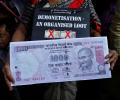
In a big win for the Narendra Modi government, the Supreme Court in a 4:1 majority verdict on Monday gave its stamp of approval to the Centre's 2016 decision to demonetise the Rs 1,000 and Rs 500 denomination currency notes, saying the decision-making process was neither flawed nor hasty.

This election will be remembered for being the first election where the Election Commission failed to take action on gross violations involving the ruling party that repeatedly used religion, communal slurs, lies and undocumented allegations, observes Ramesh Menon.
The Reserve Bank of India has observed that several banks were not complying with the guidelines issued by it on reporting revaluation of foreign currency assets and liabilities, which sometimes led to errors.\n\n

Such minutes will be available within two weeks from the date of its confirmation in the next meeting of the central board and on being signed by the chairman in the same meeting, the RBI said in a statement on its website.

April policy could be all about RBI communication.

According to the Centre's legislative business list for the upcoming session, three bills have also been listed to replace three ordinances.
The differences revolved around the two topics of how much reserves the RBI should carry and whether the finance ministry had precipitated matters by invoking Section 7 of the RBI Act, that allows it to give directions to the RBI in public interest.

'Overall, domestic demand has moderated significantly. 'The weakening of private consumption, which for long has been the bedrock of aggregate demand, in particular, is a matter of concern,' RBI Governor Shaktikanta Das said in the MPC meetings, in October.

The RBI governor, D Subbarao had met finance minister Pranab Mukherjee on December 18, fuelling speculation that the monetary policy would be tightened.
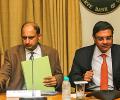
'Those who come from outside are surprised at the relatively small strength of the RBI supervisory cadre, relative to the needs of the country and the needs of the financial sector.'

Rajan warned against waiting to act until inflation expectations become entrenched, but also said the Reserve Bank of India would overlook temporary spikes in inflation.
Remittances by artists and for advertisements, royalty payments, purchase of trademarks, commission to real estate agents and health insurance from abroad would no longer require RBI clearance.

The bond, which the Reserve Bank of India started issuing on behalf of the Union government in 2003, was considered one of the safest savings instruments for retail investors.
